Owners selling or bringing in a partner
Defend the value on future cash flow, not on machinery or past turnover. Value range, cross-method consistency and an exit scenario are ready for the negotiation.
Or want to know what your Turkish business is worth?
VALOR reads the Turkish trial balance and financial statements directly and produces a report of around 100 pages in 13 main chapters: value range in TRY and USD, borrowing capacity, risk map and value creation roadmap. Written in the language a buyer, a bank committee and an investment board read, with the source of every figure visible.
High inflation and the exchange rate distort reported figures; a company that looks profitable in lira may tell a different story in dollars. Much of the detail sits in the Turkish trial balance (mizan) under the national uniform chart of accounts, which international buyers and lenders rarely read. VALOR reads those records directly, tests them for consistency and rebuilds the company's earning power on a comparable basis, in both TRY and USD.
Data loaded into the system is not used to produce results directly. It first passes consistency checks; the relationships between the balance sheet, the income statement and the cash flow are compared. The aim is to show sustainable operating strength, not only the results recorded in the books.
Defend the value on future cash flow, not on machinery or past turnover. Value range, cross-method consistency and an exit scenario are ready for the negotiation.
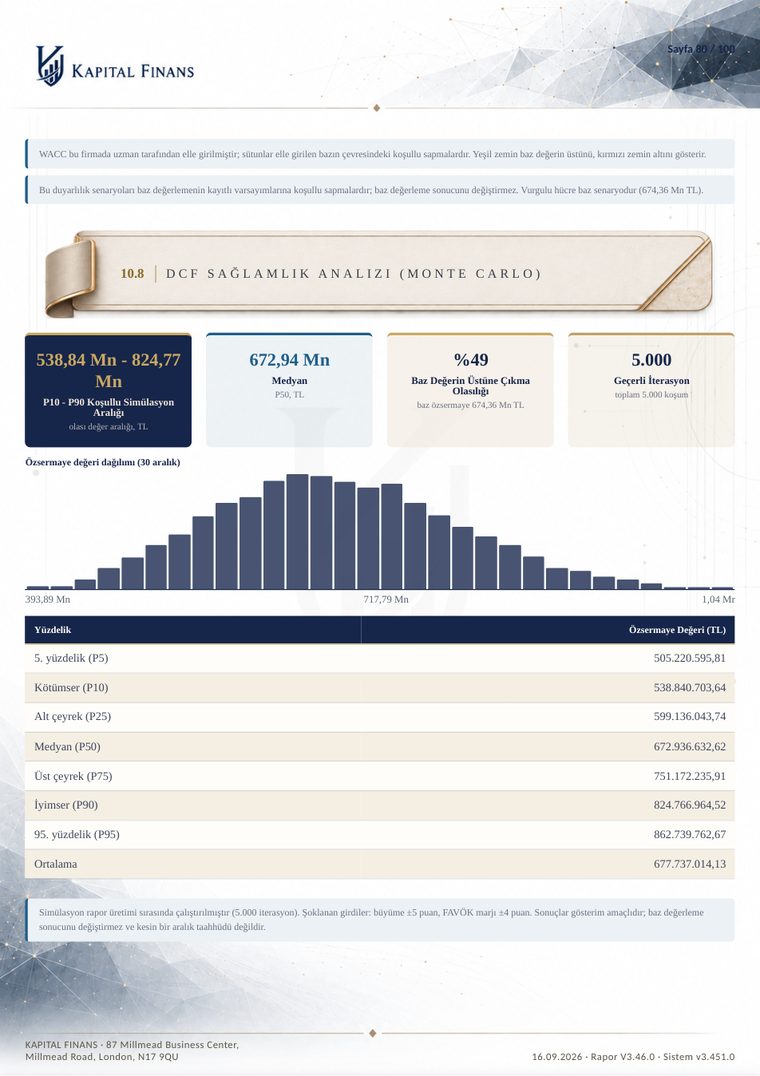
See whether the asking price is reasonable. Comparable multiples, Borsa Istanbul sector multiples, a Monte Carlo distribution and tornado sensitivity on the same page, in TRY and USD.
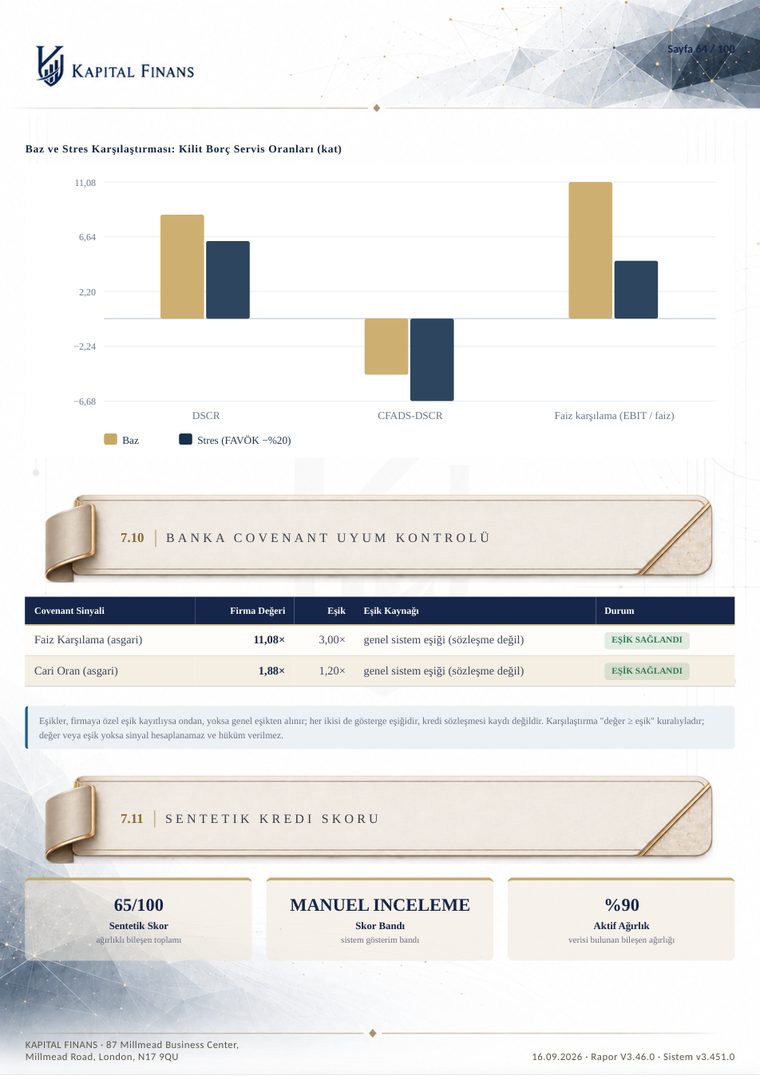
The key measures a lender looks at are calculated in advance: DSCR, the CFADS bridge, borrowing capacity and its binding constraint, covenant compliance, collateral and haircuts.
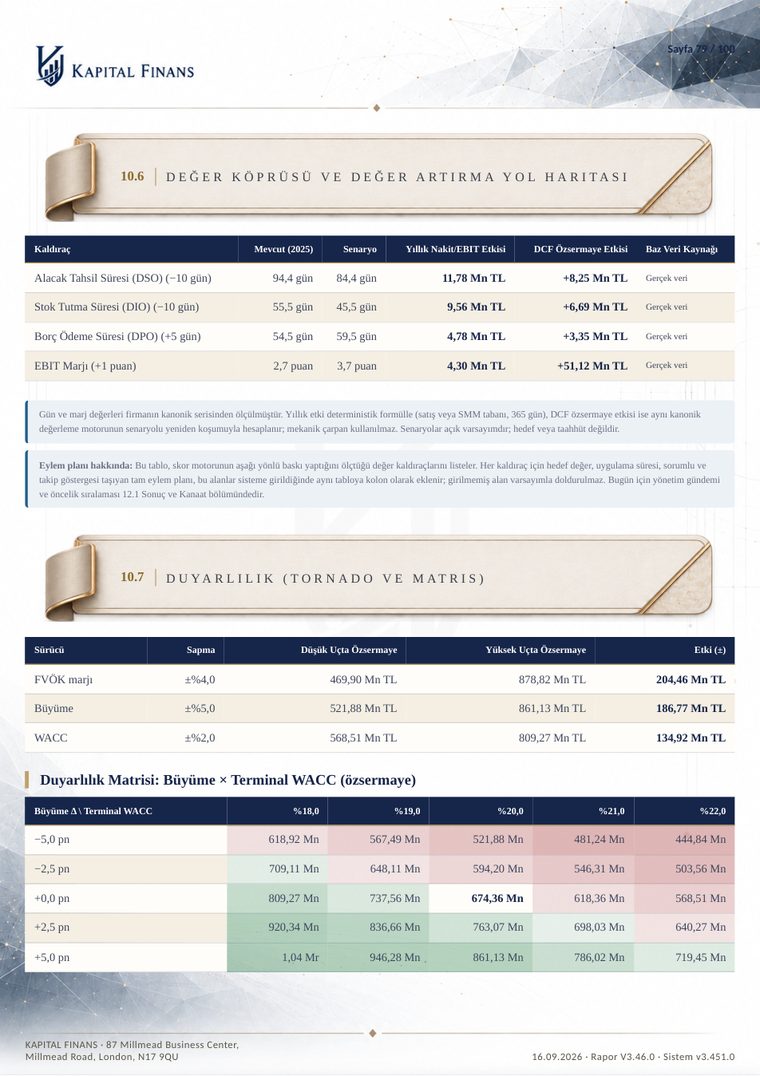
Value drivers, the spread between ROIC and WACC, margin change analysis and a value creation roadmap: which lever moves value, and by how much.
Purpose, scope, principles, assumptions, limitations and ethical framework of the valuation. What the report claims and what it does not claim is written up front.
Company details, history, ownership and key person dependency, product, customer and market concentration, sales breakdown, legal status.
Equity value, enterprise value, value range and decision summary on one page. The investor score rates strengths and areas of attention.
Sector outlook, Turkish macroeconomic outlook, competitors and peers, company versus sector comparison using Central Bank of Turkey data by NACE code, position within the sector.
Historical financials, growth and margins, CAGR in TRY and USD, margin change analysis, performance indicators, DuPont analysis, cost structure.
Indirect cash flow statement, working capital days and the net cash cycle, investment plan, reinvestment and return on capital, the spread between ROIC and WACC.
Liquidity and leverage, debt and maturity structure, DSCR, CFADS bridge, borrowing capacity and the binding constraint, maturity scenario matrix, collateral and haircuts, receivables concentration, stress test, covenant compliance, synthetic credit score, credit readiness checklist, Altman Z early warning.
Assumptions, three scenarios over ten years, free cash flow build-up, projection summary in TRY and USD, projection realism check.
Normalised EBITDA, balance sheet and value adjustments, discount rate (WACC) build-up with an inflation-linked path, terminal value, the bridge from enterprise value to equity, cross-method consistency.
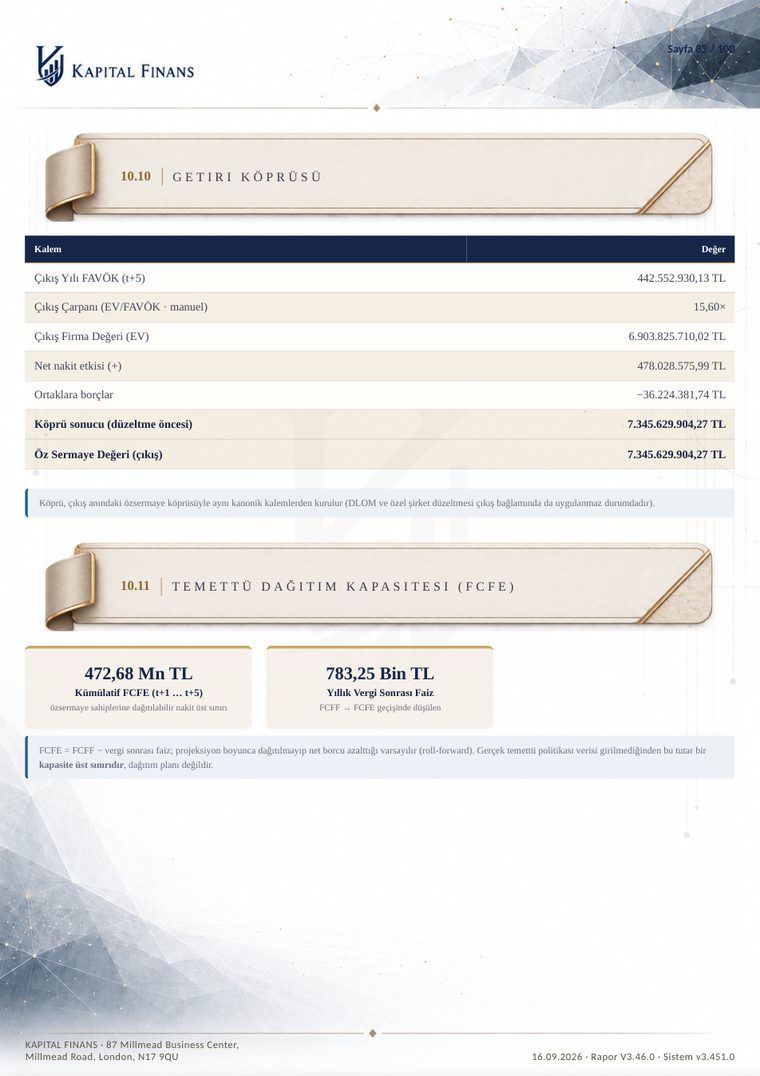
Result and method badges, value range (football field), comparable and Borsa Istanbul sector multiples, net asset value, value bridge and value creation roadmap, tornado and matrix sensitivity, Monte Carlo robustness analysis, investor exit scenario, return bridge, dividend capacity.
Risks, catalysts, financial anomalies and checkpoints, SWOT, a financial check-up report card and data integrity checks.
Opinion, priority ranking and management agenda; data source note.
Full multi-year financial statements, ratio detail, full Altman Z table, source status table, calculation method and formula set, data coverage and quality.
An unsupported forecast, an arbitrary multiple or a value written after a glance at a few ratios is easy. The hard part is showing where every line comes from. Six things set Valor apart:
The balance sheet, income statement and cash flow are reconciled against each other. One-off items, related party transactions and unusual entries are separated. The anomaly scan is visible in the report.
Central Bank of Turkey sector balance sheets, comparison by NACE code, the inflation path, exchange rates, country risk premium, Damodaran data sets and a sector beta estimated from Borsa Istanbul panel data. International methodology, local data.
The questions a credit committee asks are answered in advance: debt service coverage, the capacity constraint, maturity scenarios, collateral quality, covenant signals and a synthetic credit score.
A range instead of a point value: three scenarios, a ten-year projection, a 5,000-run Monte Carlo simulation, tornado charts and a growth by WACC matrix. You can read how far the value can move.
What happens to value if collection days fall by ten? If the margin rises by one point? The effect of each lever on equity value is calculated; the report ends with an action plan, not just a diagnosis.
A source note on every page, data quality warnings and a formula set appendix. What was assumed, what was measured and what is unknown are all written down. No parameter is published without expert approval.
The pages below are taken from a real report produced by the system (Turkish edition). Each chapter opens with a numbered heading; company details, page number and version are printed on every page.
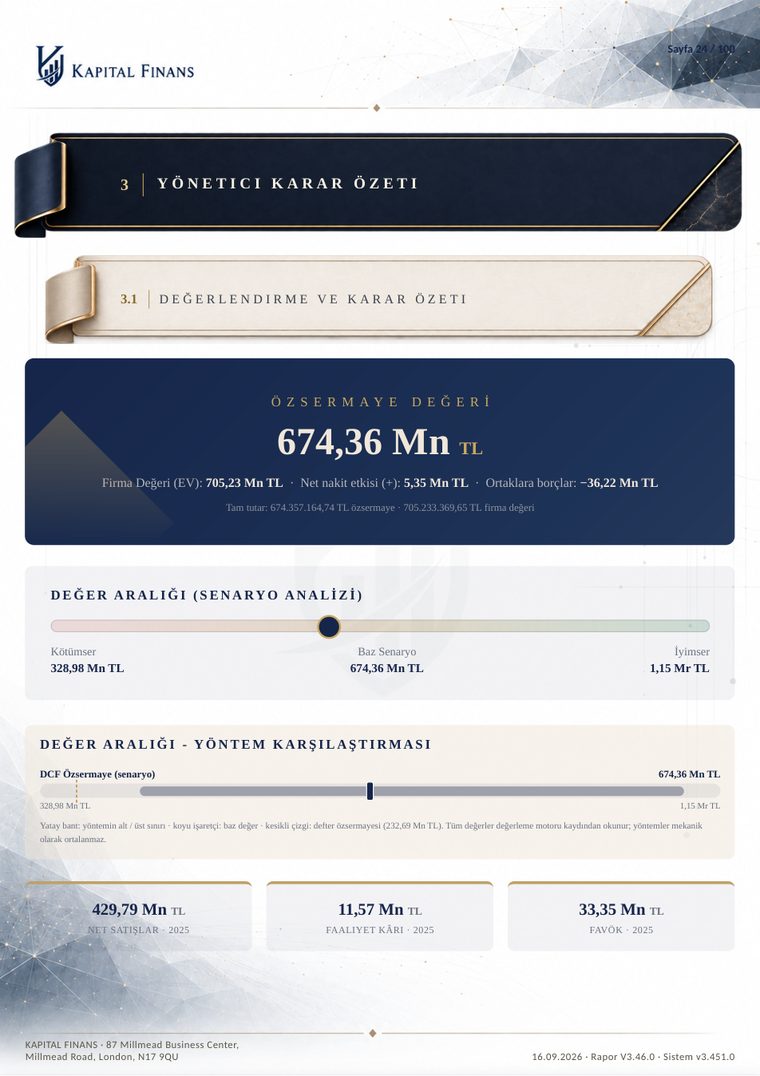
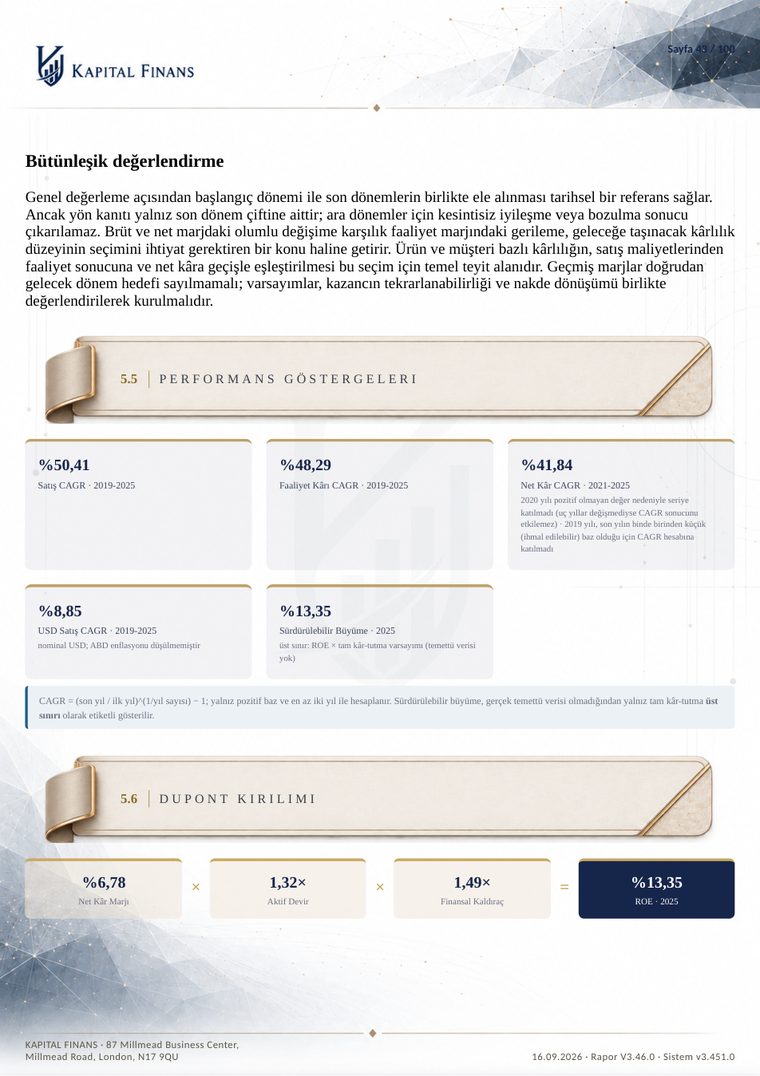
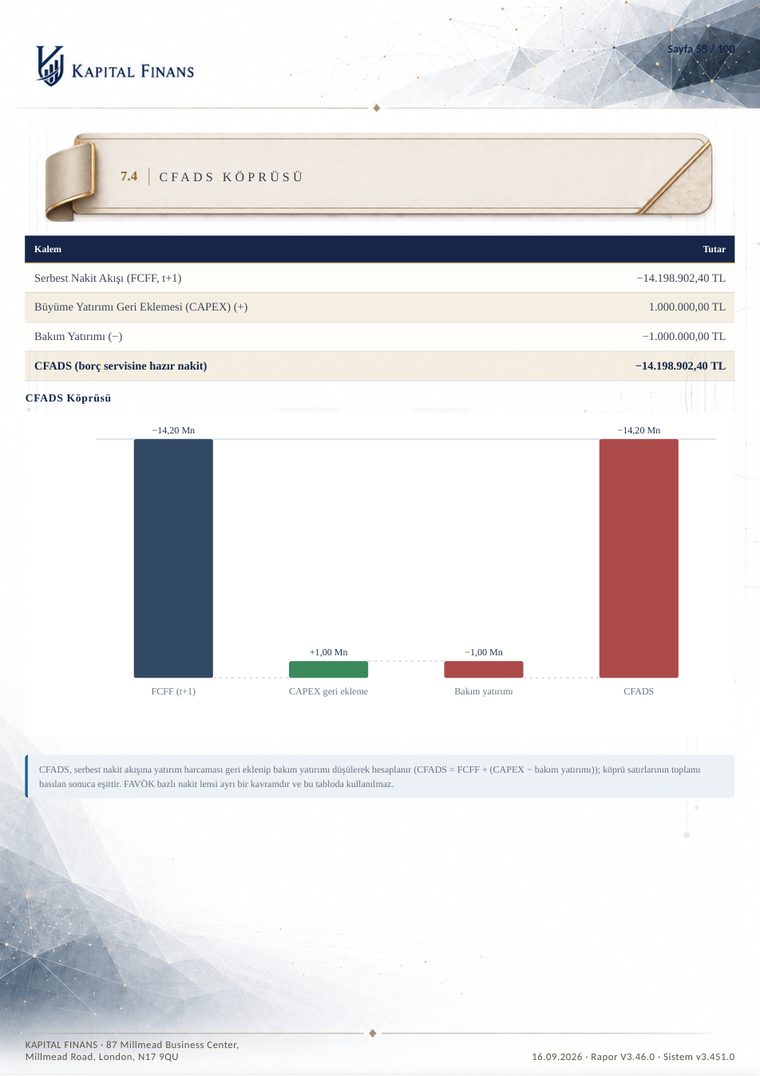
Amounts shown in the images belong to a sample company and are for illustration only.
Trial balance, balance sheet and income statement; ideally the last five to seven years. We work from the Turkish originals; no translation is needed on your side.
Documents are parsed, accounts are mapped and consistency checks run. Anomalies are flagged and missing data is listed openly.
WACC, terminal growth and normalisation decisions are recorded with their rationale and approved by an expert. No unapproved parameter is published.
The report is delivered as a PDF and on an online panel, with an English summary and discussion available for international readers.
The scope depends on the size of the company, the number of periods reviewed and your purpose: a sale, a partner's entry, an acquisition, a bank application or a board decision. After a short initial call we send a written proposal and a sample report.
After your request we hold a short initial call, share the document list and agree the timetable. Delivery depends on receiving the documents in full.
We are a UK-based advisory working in corporate finance, company valuation and debt restructuring, specialised in Turkish companies. Valor is the platform we built to bring the reports we write in the field under one methodology, one formula set and one quality gate. The parameters that drive the valuation are not published without expert approval.
Kapital Finans, United Kingdom · 87 Millmead Business Center, Millmead Road, London, N17 9QU
Phone: +90 532 669 48 68 · info@kapitalfinans.com